I Kept Thinking My Dog Was Fine Alone — Until the Camera Caught *That* Moment
You know that nagging worry when you leave your pet at home? I felt it every time I headed to work. Was my dog eating? Panicking? Chewing the couch again? Then I installed a pet camera — not just for peace of mind, but as a way to *track* his behavior over time. What I discovered wasn’t just about safety; it changed how I work, when I check in, and even how much I get done. This is more than a gadget — it’s a quiet game-changer for pet parents trying to balance life, love, and productivity.
The Guilty Goodbye: That Moment We All Know
There’s a moment — just before you close the front door — when you catch your dog standing in the hallway, head tilted, eyes wide, tail low. You smile, say “Be good,” and step out, but that image lingers. I used to brush it off. “They don’t understand time,” I’d tell myself. “He’ll nap, eat a treat, and be fine.” But deep down, I wasn’t so sure. Over time, little things started to add up — a shredded slipper, the trashcan tipped over, water splashed across the kitchen floor. Each one was a quiet accusation: You left him alone. He was stressed. You weren’t there.
And honestly? That guilt followed me all day. I’d be sitting in a meeting or drafting an email, and suddenly my mind would drift: Is he barking? Is he pacing? Did he even eat breakfast? It wasn’t constant, but it was frequent enough to chip away at my focus. I thought I was being a responsible pet parent — feeding him, walking him, loving him. But I wasn’t really seeing him. Not when it mattered. I was guessing. And every guess came with a tiny emotional tax — one that drained my energy and scattered my attention. I realized then that my dog’s well-being wasn’t just his issue. It was mine too. My peace of mind was tangled up in his calm — and I couldn’t give my best to my job, my family, or myself if I was always wondering what was happening at home.
From Panic to Progress: How Watching Became Learning
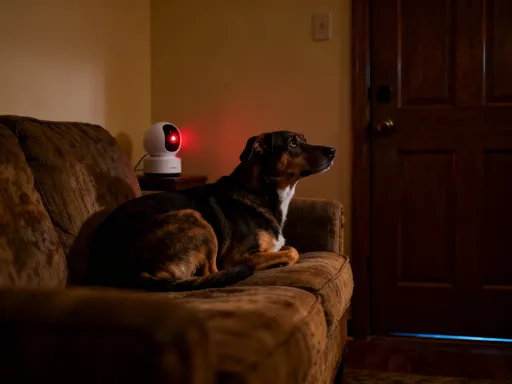
So I bought a pet camera. Not the fanciest one — just a simple, Wi-Fi-connected device with a wide-angle lens and two-way audio. I mounted it in the living room, pointed it at his favorite spot on the rug, and crossed my fingers. At first, I used it like most people do — I’d open the app when I missed him, watch him sleep, and say “Hi, buddy!” through the speaker. It was sweet, but it felt a little silly. Was I really just using a high-tech baby monitor for my dog?
Then one afternoon, I noticed something. At exactly 3:15 p.m., he bolted upright, ears forward, tail stiff. The mail had just been delivered. He barked twice, then circled the room before settling back down. I watched the replay three times. It wasn’t random. It was patterned. That’s when it hit me: this camera wasn’t just for checking in — it was a window into his world. I started watching more intentionally. I began taking notes — not formal ones, just quick voice memos on my phone. Barked at delivery guy. Ignored food until I waved. Slept from 1:00 to 2:30. Got excited when the neighbor’s dog barked outside. Over time, these fragments started to form a picture. My dog wasn’t just “fine” or “not fine.” He had rhythms, triggers, preferences. And for the first time, I could see them.
This wasn’t surveillance. It was understanding. It was like learning a new language — one spoken in tail wags, ear flicks, and nap locations. And with that understanding came something powerful: the ability to help him. Not guess. Not hope. Help. That shift — from worry to action — changed everything.
The Hidden Cost of Worry: How Pet Anxiety Drains Work Focus
We don’t talk enough about how emotional stress sneaks into our workdays. It’s not always a big crisis — sometimes it’s a quiet hum in the background, like a refrigerator that won’t shut off. My hum was my dog. Every time I wondered if he was okay, it pulled me out of the present moment. I’d be writing a report and suddenly pause, picturing him alone in the apartment. Or I’d delay responding to an email because I needed to check the camera “real quick.” These weren’t huge interruptions, but they happened multiple times a day. And each one carried a cognitive cost.
Psychologists call it “attention residue” — the mental hangover from switching tasks. When part of your brain is still stuck on something else, you can’t fully engage with what’s in front of you. I was showing up at work, but I wasn’t all there. A study from the University of California found that even brief emotional distractions can reduce productivity by up to 40%. That’s not a small number. Imagine losing nearly half your focus — not because you’re lazy or disorganized, but because your heart is back at home, worrying about your pet.
The pet camera didn’t just show me my dog. It showed me how much of my own mental energy I was losing. Once I could see him calm and resting, I didn’t need to wonder. I could trust. And that trust gave me back my focus. I stopped sneaking glances at my phone. I stopped second-guessing. I could finally work — really work — because I knew he was okay. It wasn’t just about him. It was about me reclaiming my attention, my time, and my peace.
Small Data, Big Insights: Turning Clips into Care
You don’t need AI, facial recognition, or a 4K ultra-slow-motion lens to get value from a pet camera. What you need is curiosity and five minutes a day. I started treating my observations like a gentle experiment. I wasn’t trying to fix everything at once — just learn. I noticed that my dog rarely ate his breakfast unless I waved at him through the camera. That seemed odd at first, but then I realized: he wasn’t hungry. He was waiting for connection. The moment he saw me — even on a screen — he felt acknowledged. And then, and only then, would he eat.
That changed how I started my mornings. Instead of rushing out the door, I’d take 30 seconds to open the app, say his name, and wave. I’d watch him perk up, trot to the bowl, and start eating. That tiny ritual didn’t just help him — it helped me. It gave me a moment of calm before the day began. It reminded me that I was seen too — by him, through the camera, in that little digital loop of love.
I also noticed his barking wasn’t random. It peaked between 3:00 and 3:30 p.m. — right when the mail came, the delivery trucks passed, and the upstairs neighbor walked her dog. Noise was his trigger. So I tried something simple: I plugged in a white noise machine and set it to turn on automatically during those hours. I watched the clips the next day. He still startled at the door knock — but he didn’t bark. He looked around, settled, and went back to sleep. The change wasn’t dramatic, but it was real. And it was measurable.
I shared these observations with my vet. She wasn’t surprised. “Dogs thrive on predictability,” she said. “When we understand their triggers, we can create routines that help them feel safe.” She suggested adjusting his walk schedule and adding a calming chew in the afternoon. I followed her advice — and kept watching. Over the next few weeks, the barking dropped by more than half. His naps got longer. He started eating on his own. These weren’t miracles. They were progress. And because I could see the progress, I felt like I was actually making a difference.
Routines Reimagined: How Pet Monitoring Shapes Your Day
Once I had better insights, I started reshaping my workday — not around meetings or deadlines, but around moments of connection. I scheduled three quick check-ins: one in the late morning, one at lunch, and one in the mid-afternoon. These weren’t distractions. They were anchors. I’d pause between tasks, open the app, and just watch for a minute. If he was sleeping, I’d smile and close it. If he looked restless, I’d say his name or play a recorded command like “Settle down.”
These micro-moments didn’t pull me away from work — they grounded me. They gave me a chance to breathe, reset, and return with more focus. I wasn’t hiding my phone under the desk anymore. I was engaging with intention. And oddly, my productivity went up. I was more present during deep work because I knew I’d have structured times to reconnect. The uncertainty was gone. The guilt was gone. In its place was rhythm — a quiet, predictable flow that worked for both of us.
I even started using the camera during video calls. If I had a short break, I’d leave the app open on a second screen, just to keep an eye on him. One day, a colleague noticed. “Is that your dog?” she asked. I nodded, a little self-conscious. “Yeah, he’s napping.” She smiled. “I do the same thing. It’s like having a little piece of home with you.” That moment stuck with me. I wasn’t the only one. So many of us are trying to balance care and career, love and logistics. And sometimes, a small piece of technology can hold that balance for us — gently, quietly, without fanfare.
Beyond Safety: The Emotional Payoff of Consistent Tracking
Peace of mind isn’t just about avoiding the worst-case scenario. It’s about building confidence in the everyday. When I could see my dog eating regularly, resting deeply, and responding to changes with less anxiety, I stopped worrying. I knew. And that knowledge was freeing. I didn’t have to imagine the worst. I could trust what I saw.
That emotional security didn’t just help my dog — it helped me show up better in every part of my life. I was calmer in meetings. I was more patient with my family. I had more energy to cook, to read, to just be. When you stop carrying hidden stress, you make space for joy. For creativity. For presence. The camera didn’t just monitor my pet — it nurtured our bond. And in nurturing that bond, it nurtured me.
There was one clip I’ll never forget. It was a rainy Thursday afternoon. I’d been on back-to-back calls, stressed, rushing. I opened the app during a break, expecting to see him sleeping. Instead, he was sitting upright, staring at the screen, tail thumping softly. I said his name. He tilted his head. I waved. He barked once — not loud, not frantic, but happy. Then he lay down, still looking at the camera, and closed his eyes. In that moment, I felt it: connection. Across space, across screens, across species. He wasn’t just waiting for me. He was with me. And I was with him.
A Smarter, Kinder Normal: Making It Work for You
You don’t need the most expensive camera. You don’t need to become a behaviorist. You just need to start. Pick one thing — eating, barking, resting — and watch for three days. Notice when it happens. What’s happening in the environment? Noise? Light? Routine changes? Then adjust one small thing. Move his bowl to a quieter corner. Leave a radio on. Offer a stuffed toy before you leave. Watch again. See what changes.
Over time, you’ll build a rhythm — not of control, but of care. This isn’t about perfection. It’s about presence. It’s about saying, “I see you. I’m here. Even when I’m not.” And in that presence, you’ll find something unexpected: not just a calmer pet, but a clearer mind, a lighter heart, and a more focused, fulfilling day.
Technology, at its best, doesn’t replace love. It helps it grow. It gives us eyes when we’re apart, insight when we’re confused, and reassurance when we’re worried. It doesn’t make us less hands-on. It makes us more aware, more intentional, more capable of giving the care our pets — and ourselves — deserve. So if you’ve ever stood at the door, keys in hand, heart heavy, wondering if your dog is really okay — try it. Watch. Learn. Connect. You might just find that the thing you thought was a gadget is actually a bridge — to your pet, to your peace, and to a more balanced, beautiful life.