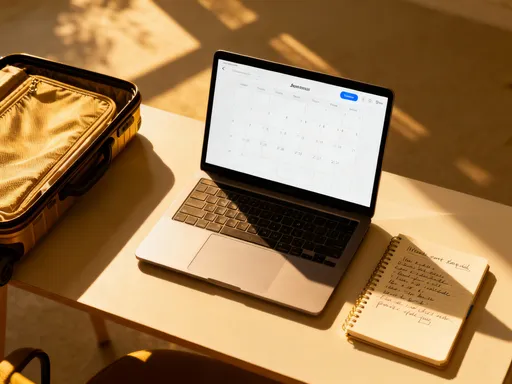
Planned my entire year in 3 hours: The app that finally made time work for me
Remember that feeling when your calendar is full, but you’ve achieved nothing meaningful? I used to juggle trips, goals, and family plans like a circus act—until I found a simple method that changed everything. It wasn’t about doing more. It was about claiming time, intentionally. One travel planning app, designed for block time organization, helped me structure not just vacations, but growth, rest, and connection. This is how it quietly transformed my life. I didn’t need more hours in the day—just a smarter way to use the ones I already had. And the best part? It didn’t require a life overhaul, just one thoughtful shift in how I saw time.
The Overwhelm of "Busy but Nowhere"
Have you ever stood in an airport, boarding pass in hand, suitcase rolling behind you, and suddenly thought: Wait—why am I doing this? That was me last winter. I was flying to a work conference I hadn’t wanted to attend, rescheduling my daughter’s birthday dinner—again—and mentally drafting an email about a side project I hadn’t made progress on in months. I was busy, yes. But I wasn’t moving forward. I felt like I was spinning my wheels while the things that truly mattered—spending time with my kids, reading more, learning something new, even just sleeping enough—kept slipping through the cracks.
My calendar looked impressive. Color-coded blocks, back-to-back meetings, flight confirmations, school events, dentist appointments. But when I stepped back, I realized something unsettling: none of it reflected what I actually cared about. There were no reminders to call my mom just to chat. No time set aside to practice the guitar I’d bought two birthdays ago. No space to breathe. I was living reactively, not intentionally. Every new request—a work trip, a friend’s wedding, a last-minute family visit—got added like another plate on a spinning pole. And I kept waiting for the crash.
Traditional calendars made it worse. They were great for logistics but terrible for priorities. They told me when things were happening, but never why. I could see that I was in Chicago on April 12th, but not whether that trip was for career growth, family connection, or just because someone said, “You should go.” The result? Burnout. Guilt. And a quiet sense that I was missing my own life. I needed a new approach—one that didn’t just track time, but helped me shape it.
Discovering Block Time Through Travel Planning
The shift started with a trip. My sister invited me to join her on a two-week hiking adventure in the Pacific Northwest. I was excited but overwhelmed by the planning—flights, gear, accommodations, permits. A friend recommended a travel planning app that promised to organize everything in one place. I downloaded it, expecting just another digital itinerary tool. What I found was something far more powerful: a visual time-blocking system that treated travel not just as a series of bookings, but as a structured experience.
Instead of just listing flights and hotels, the app let me drag and drop blocks of time—like “rest days,” “skill-building hikes,” “journaling mornings,” and “connection hours” with my sister. I could see the entire two weeks laid out in color-coded segments, not just for logistics but for intention. One day wasn’t just “Day 5 in Oregon”—it was “Deep Nature Immersion + Reflection.” Another was “Physical Challenge + Gratitude Practice.” Suddenly, the trip wasn’t just something I was doing—it was something I was designing.
And then it hit me: If I can plan a trip this way, why not my whole life? What if, instead of reacting to my calendar, I could design it with the same care and clarity? What if I could block time not just for where I was going, but for who I wanted to become? That night, I opened the app and did something I’d never done before: I created a block called “Personal Growth Week” and dropped it into my calendar three months out. No destination. No agenda. Just space—intentional, protected space—to read, reflect, and recharge. It felt radical. It felt necessary.
How the App Turned Schedules Into Intentions
The magic of the app wasn’t in its features—it was in its philosophy. It treated time as a canvas, not a container. Instead of filling days with tasks, it encouraged me to assign meaning to them. The interface was simple: a monthly view with draggable blocks. I could create custom categories like “Family Connection,” “Creative Time,” “Learning,” “Rest,” and even “Digital Detox.” Each block could be labeled, color-coded, and expanded with notes—like a digital vision board for my time.
One of my first experiments was to drag a “digital suitcase” icon into next month’s calendar and label it “Skill-Building Retreat.” No real trip was planned—this was symbolic. But by placing it there, I committed to using that week for focused learning: taking an online course, practicing a new language, and writing daily. The app sent me gentle reminders. I started preparing—buying books, clearing my schedule, telling my family, “This is my week to grow.” And when the week arrived, I honored it. I didn’t let meetings creep in. I didn’t say yes to last-minute requests. That block became sacred.
The emotional shift was profound. For years, I’d felt like time was something that happened to me. Now, I felt like I was part of the design. I wasn’t just managing my schedule—I was shaping my life. The app didn’t add more time, but it gave me clarity. I could finally see the difference between being busy and being purposeful. And that changed everything.
Building a Year That Reflects Who I Want to Be
With that new mindset, I decided to plan my entire year—not just my vacations, but my growth, my rest, my relationships. I opened the app on a quiet Sunday morning, poured a cup of tea, and gave myself three hours. No distractions. Just me and my calendar.
I started by identifying my core values: family, health, creativity, learning, and peace. Then, I created time blocks that reflected those values. A hiking trip in the Rockies became “Physical Resilience Training.” A weekend in New York with my daughter turned into “Creativity Reboot”—we planned to visit museums, try a pottery class, and write stories together. Even my annual family beach vacation was reimagined as “Connection & Legacy Building,” with intentional moments for storytelling, photo albums, and heart-to-heart talks.
The real breakthrough was syncing personal growth with family time. Instead of seeing them as competing priorities, I found ways to weave them together. I blocked a “Silent Morning Practice” during our beach trip—waking up early to journal and meditate before the kids woke up. I scheduled “Learning Walks” where my son and I would explore a new trail and talk about science or history. I even created a “Family Vision Night” once a month, where we’d review our shared calendar and talk about what mattered most.
By the end of those three hours, my calendar looked different. It wasn’t packed—it was purposeful. Each month had breathing room. Each season had rhythm. And for the first time, my schedule reflected not just what I had to do, but who I wanted to be.
The Ripple Effect on Focus, Energy, and Relationships
The changes didn’t stop at planning. They spilled into my daily life in ways I hadn’t expected. At work, I found myself more focused. Why? Because I knew my “growth blocks” were protected. I didn’t feel the pressure to learn everything on the fly. I had time set aside to do it right. I became more present in meetings because I wasn’t mentally juggling ten other things. My energy improved—no more Sunday-night dread, because I could see that the next week included real rest, not just empty slots.
My relationships deepened too. One evening, my neighbor called, excited about a spontaneous weekend trip. In the past, I would’ve said yes—fearful of missing out, eager to please. This time, I smiled and said, “I’d love to, but that weekend is my ‘recharge block.’ I’ve been looking forward to it all month.” She paused, then said, “You know what? I need one of those.” We laughed, but it was true. Setting boundaries wasn’t selfish—it was sustainable.
With my kids, I was more patient. Because I wasn’t constantly drained, I had more emotional bandwidth. I started small traditions: “Tuesday Tea Talks” where we’d brew herbal tea and share highs and lows of the week. I wasn’t just their mom—I was becoming someone they could talk to, not just for logistics, but for life.
And the biggest surprise? Peace. Not the absence of stress, but the presence of control. Seeing my year laid out in intentional blocks gave me a sense of calm I hadn’t felt in years. Time wasn’t a countdown. It was a design project. And I was the architect.
How You Can Start Small (Even If You’re Skeptical)
I know what you might be thinking: This sounds nice, but I don’t have three hours. I don’t even have three minutes. I get it. I was skeptical too. But here’s the good news: you don’t need to plan a whole year to start. You just need one trip. One weekend. One block of time.
Here’s how to begin: pick an upcoming trip—any trip. It could be a family visit, a short getaway, even a business conference. Open the app (or use any calendar with time-blocking features). Instead of just adding flights and hotels, create three intention blocks: one for rest, one for connection, one for growth. Maybe it’s “Unplugged Morning” on Saturday. Or “Heart-to-Heart Walk” with your sister. Or “New Skill Practice” during a free afternoon.
Then, link one of those blocks to a personal goal. If you want to read more, block 30 minutes a day for a book. If you’re learning to cook, schedule a “Family Recipe Night.” If you’re feeling disconnected, plan a “Phone-Free Dinner.” The key isn’t perfection—it’s intention. It’s saying, “This time matters. I’m not just passing through—I’m showing up.”
A friend of mine tried this for a weekend cabin trip. She blocked “Sunrise Coffee & Journaling” and “No Screens After 7 PM.” She told me, “I thought it would feel rigid. But it was the most relaxed weekend I’ve had in years.” That’s the power of design. When you plan with purpose, you create space for presence.
Time Isn’t Just Spent—It’s Shaped
Looking back, I realize the app didn’t change my time. It changed my relationship with time. What began as a tool for travel planning became a companion for life planning. It taught me that self-development doesn’t require grand gestures—just small, consistent acts of claiming time. A morning to breathe. An afternoon to learn. A weekend to reconnect.
I used to think time was something I was running out of. Now I see it as something I can shape. Not perfectly. Not all at once. But with care. With love. With intention. Every block I place in my calendar is a quiet promise to myself: You matter. This moment matters. Your growth, your rest, your joy—they’re not luxuries. They’re the foundation.
So I’ll leave you with this: What could your next block of time truly be for? Not what you have to do. Not what others expect. But what your heart needs. A moment of stillness? A burst of creativity? A deep conversation? However small, protect it. Design it. Live it. Because time isn’t just spent—it’s shaped. And you, my dear, are the artist.